We love our pets more than anything. We love the morning snuggles, the greeting at the door, and even the hair they leave on our black sweaters. But let’s be real for a second: we do not love the smells that come with them.
Whether it is the lingering “wet cat” scent on the sofa or the ammonia wafting from the litter box, pet odors are a constant battle for animal lovers.
The natural reaction is to reach for a can of air freshener or plug in a scented oil diffuser. But before you spray that “Tropical Breeze” mist, pause for a moment. Most commercial air fresheners are loaded with Volatile Organic Compounds (VOCs), phthalates, and synthetic fragrances that can be incredibly harmful to your pet’s sensitive respiratory system.
The good news? You don’t have to choose between a fresh-smelling home and your pet’s health. Nature offers powerful, effective deodorizers that are 100% safe for your four-legged family members.
Here are 5 natural ways to eliminate odors without using toxic chemicals.
Why Traditional Air Fresheners Are Dangerous for Pets
It is important to understand why we are ditching the chemical sprays.
Our pets—especially cats—are much smaller than us and have faster metabolisms. Their lungs are more sensitive to airborne particulates. When you spray an aerosol or use a plug-in, the chemical droplets land on your pet’s fur. Later, when they groom themselves, they ingest those chemicals.
Furthermore, traditional air fresheners rarely remove the odor; they simply mask it with a1. Activated Charcoal Bags (The Silent Odor Eater)
If you are looking for a “set it and forget it” solution, activated charcoal is the gold standard.
Unlike baking soda or sprays, bamboo charcoal doesn’t mask smells—it absorbs them. The charcoal is incredibly porous, acting like a magnet for moisture and odor particles floating in the air.
Why it’s a winner:
Where to use: Place one near the litter box area. This is a game-changer if you are struggling with the strong biological odors we discussed in our guide on [Why Does My Cat’s Poop Smell So Bad]. It helps trap the ammonia gas before it spreads to the rest of the house. stronger, artificial scent. This creates a “perfumed trash” smell that can actually be more nauseating than the original odor.
Non-Toxic: If your cat accidentally rips one open, it’s just messy, not poisonous.
Reusable: Once a month, place the bag in direct sunlight for an hour. The UV rays “recharge” the charcoal by releasing the trapped odors, making it ready to use again.
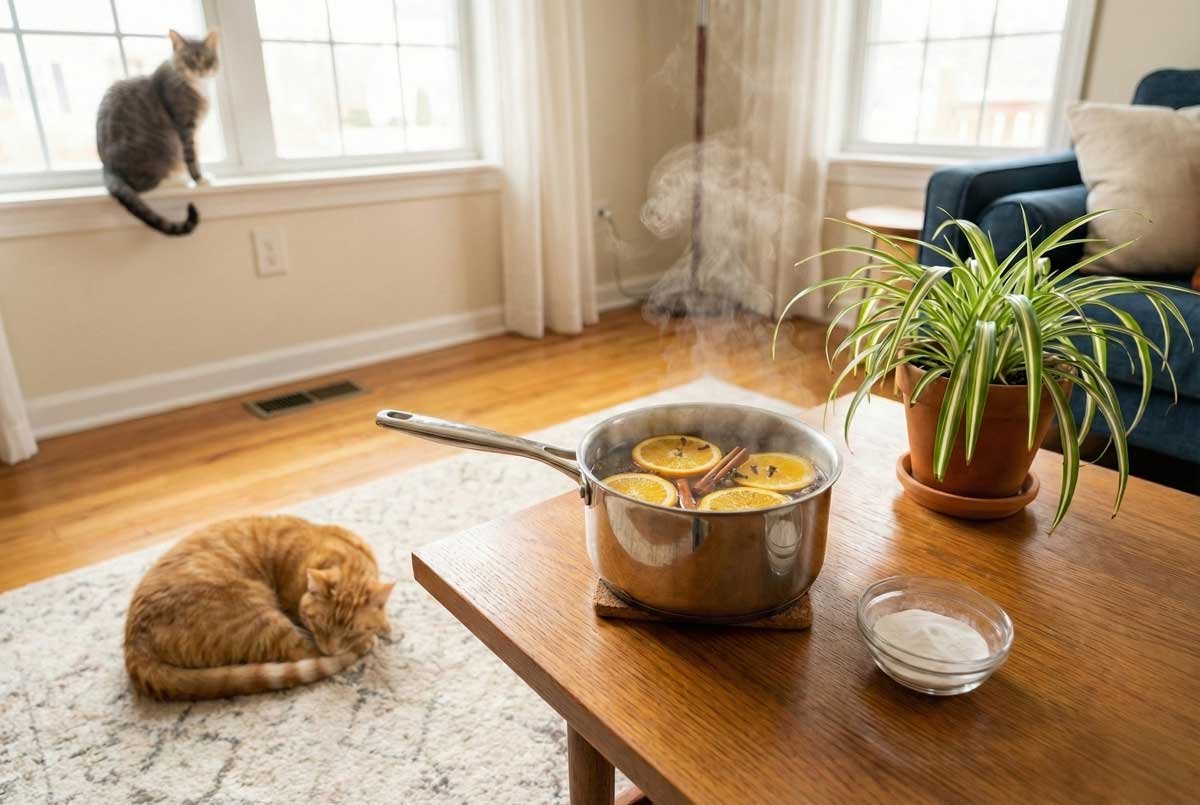
2. The DIY “Simmer Pot” (Stovetop Potpourri)
Want your house to smell like a cozy autumn afternoon? Skip the scented candles (which often contain paraffin wax that releases carcinogens) and use your stove.
A simmer pot uses steam to diffuse natural scents throughout your home. It adds humidity to dry air and smells incredible.
A Pet-Safe Recipe:
- Fill a small pot with water.
- Add sliced apples.
- Add 2-3 cinnamon sticks.
- Add a splash of vanilla extract.
- Simmer on low heat.
Safety Note: While citrus (lemon/orange peels) smells great to us, the oils can be irritating to some cats if the concentration is too high in the air. Stick to apple and cinnamon for a universally safe option.
3. Baking Soda Carpet Deodorizer
Soft surfaces like carpets, rugs, and fabric sofas are notorious for holding onto pet smells. This is because the fibers trap dander and body oils.
Instead of buying expensive carpet powders (which often irritate pet paws), use plain old Baking Soda (Sodium Bicarbonate).
The Method:
- Sprinkle a generous amount of baking soda over your carpet or sofa.
- Let it sit for 15 to 30 minutes. The baking soda chemically neutralizes acidic odors (like urine) rather than covering them up.
- Vacuum it up thoroughly.
Why it works: Baking soda balances pH levels. Most foul smells are acidic, and baking soda is basic, so they cancel each other out.
4. White Vinegar: The “Salad Dressing” Solution
This might sound counterintuitive. “You want me to clean my house with vinegar? Won’t it smell like a pickle jar?”
Yes, but only for a few minutes.
White vinegar is an acetic acid that destroys bacteria and neutralizes odors. When you wipe down a surface with a 50/50 mix of water and vinegar, it smells strong while it is wet. However, as soon as it dries, the vinegar smell vanishes completely—taking the bad pet odors with it.
It is safe to use on hardwood floors, walls (where a pet might rub), and even to wipe down plastic litter boxes during your monthly deep clean.
5. Air-Purifying Houseplants
One of the most natural ways to clean your air is to let nature do the work. Certain houseplants are famous for filtering toxins and producing fresh oxygen.
However, you must be careful. Many common plants (like Lilies, Aloe Vera, and Pothos) are toxic to cats and dogs.
Safe, Air-Purifying Options:
- Spider Plant: Safe for cats and dogs, and great at filtering pollutants.
- Boston Fern: Acts as a natural humidifier and air filter.
- Bamboo Palm: Non-toxic and adds a tropical vibe while cleaning the air.
Crucial Guide: Essential Oils (The Danger Zone)
This is the most critical section for pet owners. Many people assume ‘Essential Oils are natural, so they must be safe.’ However, according to the experts at the [Pet Poison Helpline], this is a dangerous myth because highly concentrated oils can be rapidly absorbed through the skin or lungs, leading to toxicity
Cats, in particular, lack a specific liver enzyme (glucuronyl transferase) needed to break down certain compounds found in essential oils. Diffusing the wrong oil can lead to liver failure, respiratory distress, or seizures.
❌ TOXIC Oils (Avoid Diffusing Around Pets):
- Tea Tree (Melaleuca) – Highly toxic to dogs and cats.
- Peppermint
- Wintergreen
- Pine
- Ylang Ylang
- Cinnamon (Oil form is too potent, unlike the sticks used in simmer pots).
✅ Relatively Safe Options (Use With Caution):
- Lavender (Ensure it is high-quality and diluted).
- Chamomile
- Frankincense
Note: Always ensure the room is well-ventilated and your pet has a way to leave the room if the smell bothers them.
Conclusion
Keeping a fresh home doesn’t require a chemistry set. In fact, the simplest solutions are often the safest for your furry friends.
By swapping out chemical sprays for charcoal bags, baking soda, or a gentle simmer pot, you can eliminate odors effectively without putting your pet’s health at risk. Next time you notice a funk in the air, skip the store-bought spray and head to your pantry instead. Your pet’s lungs (and your nose) will thank you.