So, you are thinking about expanding your furry family. Congratulations! Adding a second cat to the household is an exciting time, filled with dreams of cute cuddle puddles and double the playtime.
But then, reality sets in. You look at your apartment, then at the litter box, and wonder: “Do I really need to squeeze another plastic tub into my living room?”
It is the most common question for multi-cat owners: Can 2 cats share a litter box?
The short answer is: Technically, yes, they can share one, but in most cases, they really shouldn’t.
While some bonded pairs might tolerate sharing a bathroom, forcing two cats to use a single box is often a recipe for behavioral issues, territorial stress, and the dreaded “surprise” on your carpet.
Here is the truth about multi-cat hygiene and how to manage the litter logistics without turning your home into a sandbox.
The Golden Rule of Litter Boxes (The “N+1” Math)
If you ask any veterinarian or cat behaviorist about litter boxes, they will all give you the same mathematical formula. It’s called the “N+1 Rule”.
The rule is simple: Number of Cats + 1 = Number of Litter Boxes.
So, if you have:
- 1 Cat: You need 2 boxes.
- 2 Cats: You need 3 boxes.
- 3 Cats: You need 4 boxes.
I know what you are thinking—“Three boxes for two cats? That seems excessive!”
It sounds like a lot, but think of it from your cat’s perspective. Imagine living with a roommate who never flushes the toilet, and you only have one bathroom. You would probably get frustrated pretty quickly. Cats are fastidious creatures; having options reduces stress and ensures there is always a clean spot to go.
3 Major Risks of Sharing One Litter Box
Ignoring the N+1 rule might save you some floor space, but it comes with risks that can cause long-term headaches.
1. Territorial Aggression (The “Ambush”)
Cats are territorial by nature. In the wild, they don’t share bathroom spots because scent marks territory. If you force two cats to share one box, the dominant cat might start “resource guarding.” They might sit near the box and block the other cat from entering, or ambush them when they try to leave. This bullying often leads the victim cat to find a safer place to go, like your bed or behind the sofa.
2. The “Dirty Bathroom” Effect
Some cats are incredibly picky. If they step into the box and smell that the other cat has just used it, they might turn right around. With two cats using one box, the waste accumulates twice as fast. Unless you are scooping every few hours, the box will quickly become unappealing.
3. Medical Blind Spots (Crucial!)
This is a point many owners overlook. The litter box is often the first place you notice signs of illness.
- Is one cat peeing more than usual (a sign of diabetes)?
- Is there blood in the urine (a sign of a UTI)?
- Is one cat constipated?
If both cats share one box, it is nearly impossible to tell whose poop is whose. Having separate boxes helps you monitor each cat’s health individually.
Can They Ever Share? (Solutions for Small Spaces)
Okay, let’s be realistic. Not everyone lives in a sprawling mansion with room for three separate litter stations. If you live in a small apartment, fitting three boxes might be physically impossible.
If you must have 2 cats share fewer boxes, you need to compensate with these strategies:
Strategy 1: Go Jumbo (DIY Method)
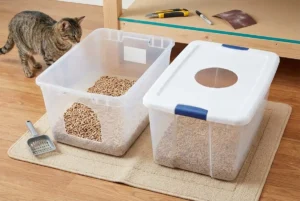
If you can’t have more boxes, get a bigger one. Most standard pet store boxes are too small for one cat, let alone two. Instead, buy a large plastic storage tote (the kind you put winter clothes in) and cut an entry hole in the side. This gives both cats plenty of room to dig and find a clean corner, reducing the “crowded” feeling.
Strategy 2: The “Hyper-Cleaning” Routine
If you reduce the number of boxes, you must increase the cleaning frequency. You will need to scoop at least 2 to 3 times a day. The goal is to ensure that whenever Cat B enters the box, they don’t find evidence of Cat A.
Pro Tip: Make sure you are cleaning effectively. Check out our guide on the Best Way to Clean a Cat Litter Box to remove deep-set odors naturally.
Strategy 3: Upgrade Your Litter
With double the traffic, odor control becomes a battle. Consider switching to Wood Pellet Litter. Unlike clay, which can hold onto urine smells, pine pellets neutralize ammonia odors naturally and are generally more sanitary for shared spaces.
Read More: Is pellet litter right for your duo? Read the Pros and Cons of Wood Pellet Litter.
Where to Place Litter Boxes for 2 Cats?
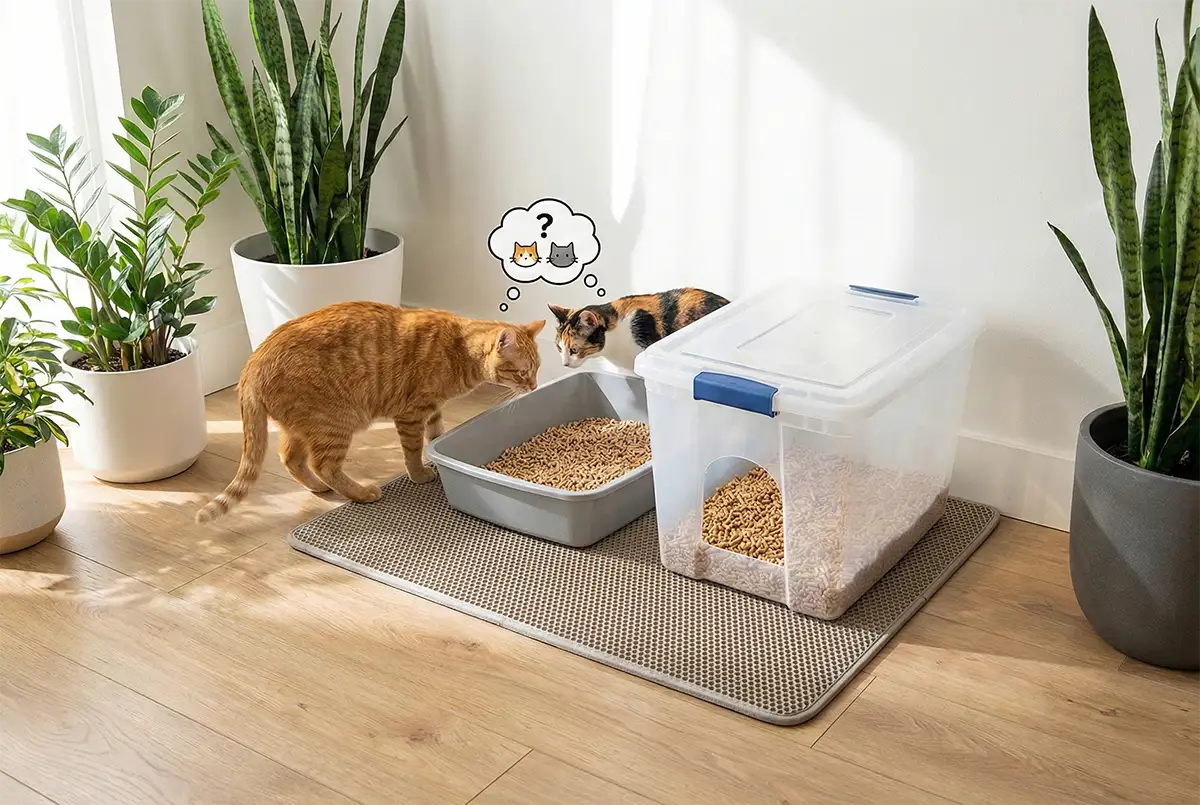
A common mistake is buying two boxes but placing them right next to each other. To a cat, two boxes side-by-side equal ONE big box.
If the dominant cat blocks the hallway leading to the boxes, they have effectively blocked access to both.
- The Fix: Spread them out. Put one in the living room and one in the bedroom (or one on each floor of the house). This ensures that if one cat is guarding a specific area, the other cat has a safe alternative route.
Signs Your Cats Are NOT Happy Sharing
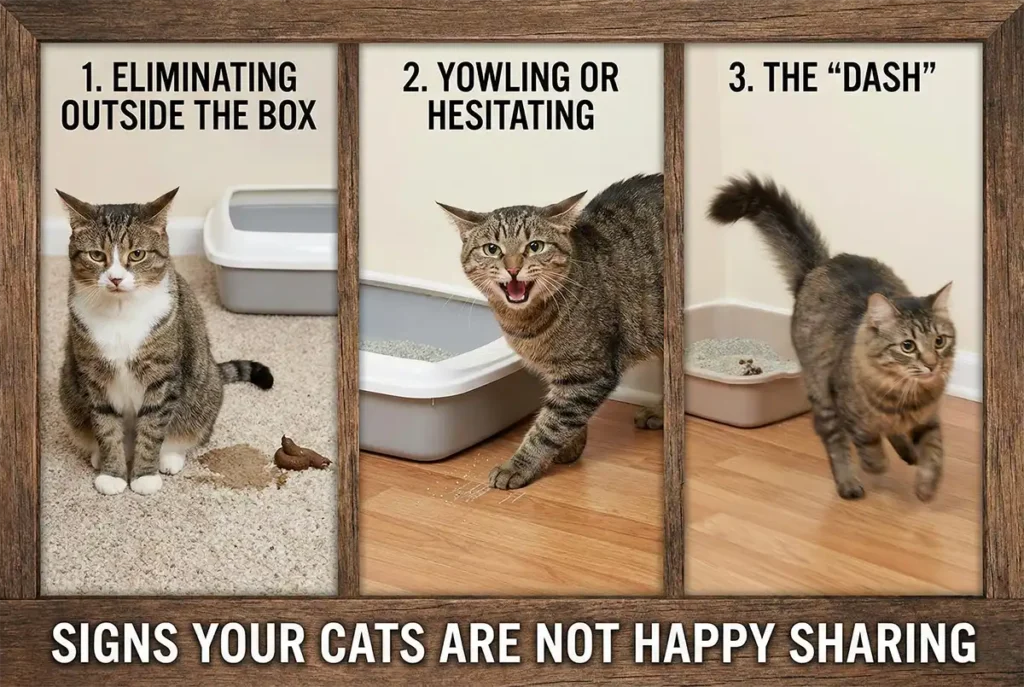
How do you know if your current setup is failing? Watch out for these red flags:
- Eliminating Outside the Box: This is the ultimate protest vote.
- Yowling or Hesitating: If your cat meows loudly before entering or scratches the floor outside the box for a long time, they are stressed.
- The “Dash”: If a cat runs out of the box immediately after finishing (without burying), it often means they felt unsafe, or the box was too dirty.
Frequently Asked Questions (FAQ)
How many litter boxes for 4 cats? Following the N+1 rule, you would ideally need 5 litter boxes. However, in a multi-cat household, you can sometimes get away with 3 or 4 extra-large boxes if they are scooped multiple times a day.
Can male and female cats share a litter box? Yes, gender usually doesn’t matter. It depends more on their individual personalities. A confident female and a shy male might struggle more than two easy-going males.
Do siblings share better? Often, yes. Littermates who have grown up together (bonded pairs) are more likely to tolerate sharing than two unrelated cats introduced later in life.
Final thoughts
Can 2 cats share a litter box? Yes. Is it the best idea? Probably not.
While you might hate the idea of a third litter box cluttering your home, dealing with behavioral issues and pee stains on your rug is far worse.
If you have the space, follow the N+1 Rule. If you are tight on space, upgrade to a Jumbo DIY Box and keep your scooping game strong. Your cats will thank you for the clean bathroom—and your nose will thank you, too!