It is a ritual every cat owner knows by heart. You walk over to the box, grab the scoop, sift through the granules, and toss the waste into the trash.
In the United States alone, cat owners throw away approximately 2 million tons of cat litter into landfills every single year.
But have you ever paused mid-scoop to wonder: What exactly is this stuff? Is it just dirt? Is it a chemical? And how did it get from the earth into this plastic bag?
The answer is more complex—and frankly, a bit dirtier—than most pet parents realize. From massive strip mines in Wyoming to recycled lumber waste, here is the deep dive into how kitty litter is actually made.
The Most Common Type: How Clay Litter Is Made
About 60% to 75% of the cat litter sold in the US is clay-based. Specifically, a type of absorbent clay called Sodium Bentonite.
Most people assume clay litter is just “dried mud.” The reality involves heavy machinery, explosives, and temperatures hot enough to melt aluminum.
Step 1: Strip Mining (The Earth Scar)
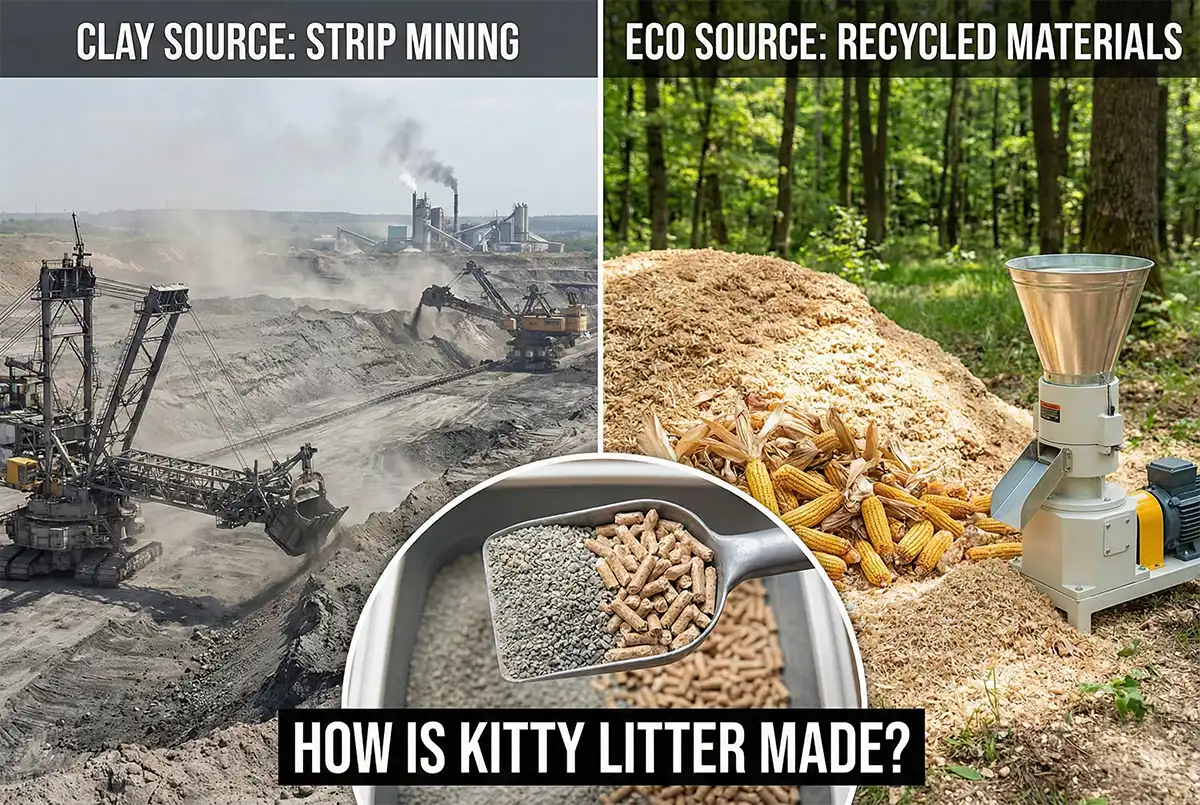
Clay litter doesn’t grow on trees; it has to be mined. The vast majority of the world’s high-quality Sodium Bentonite comes from one place: Wyoming, USA.
To get to the clay, mining companies perform “strip mining.” They blast away the topsoil and vegetation (overburden) to reach the seams of volcanic ash that settled millions of years ago. While companies are required to reclaim the land eventually, it leaves a significant scar on the landscape and disrupts local ecosystems.
Step 2: The Crush and The Bake
Once the raw clay is hauled out of the pit, it is transported to a processing plant. Here, giant crushers break the massive boulders into golf-ball-sized chunks.
Then comes the energy-intensive part. The clay is fed into massive industrial kilns (ovens) that rotate like giant cement mixers. These kilns are heated to temperatures up to 2000°F. This extreme heat removes all moisture from the clay, locking in its absorbent structure.
Step 3: Sizing and Additives
After baking, the clay is crushed again into the tiny granules you see in your bag.
- For Clumping Litter: They use Sodium Bentonite, which naturally swells up to 15 times its volume when wet. This “swelling” locks the urine into a hard clump.
- For Non-Clumping: They often use Calcium Bentonite or Fuller’s Earth, which absorbs pee but doesn’t stick together.
Finally, manufacturers add silica dust (to reduce friction), synthetic fragrances (to mask odors), and sometimes blue or green crystals (marketing visual cues).
The Hidden Danger: The crushing process creates fine silica dust. When your cat digs, this dust rises. Inhaling crystalline silica over a lifetime is a known carcinogen for humans and pets.
The Synthetic Option: How Silica Gel Litter Is Made
You know those little “Do Not Eat” packets found in shoe boxes? Silica Gel litter (often called “Crystal Litter”) is essentially the same thing, just in a larger quantity.
It Starts with Sand
Silica litter is not mined in the same way as clay. It starts as silica sand (quartz).
- Chemical Mix: The sand is mixed with water and oxygen to create Sodium Silicate.
- Pressure Cooking: This mixture is placed under high pressure and heat to create a gel.
- Micro-Pores: As the gel dries, it creates millions of tiny microscopic pores.
How it works: Unlike clay that clumps around the liquid, silica beads drink the liquid into these tiny pores and trap the odor molecules inside, allowing the water to evaporate later.
While it involves less strip mining than clay, it is still a synthetic chemical process that requires significant energy.
The Eco-Friendly Hero: How Wood & Corn Litter Is Made
This is where things get interesting for the eco-conscious owner. Unlike clay (which destroys land) or silica (which uses heavy chemical processing), natural litters are created through Upcycling.
Wood Pellet Litter (The Lumber Byproduct)
If you use Pine Pellets (which we highly recommend at EcoPawsible), you aren’t using a product that requires cutting down fresh trees.
- Sourcing: Manufacturers take kiln-dried sawdust from lumber mills—waste that would otherwise be burned or thrown away.
- Compression: The sawdust is subjected to high pressure.
- The Binder: No glue is needed! The natural lignin and resin in the wood melt slightly under pressure, binding the dust into tight pellets.
Curious about switching? Read our guide on Wood Pellet Cat Litter Pros and Cons.
Corn and Wheat Litter
These are made from agricultural leftovers.
- Corn: Manufacturers take corn cobs or kernels that aren’t suitable for food. They are dried, ground up, and compressed. The natural starch in corn provides the “clumping” action.
- Wheat: Similar to corn, secondary wheat crops are ground to release natural enzymes that neutralize odors.
Why Manufacturing Matters: Clay vs. Eco-Litter
You might be thinking, “Why does the manufacturing process matter to my cat?” It matters because the source of the material dictates its safety and environmental impact.
| Feature | Clay Litter (Bentonite) | Wood/Corn Litter |
| Source | Strip Mines (Non-renewable) | Sawdust/Farms (Renewable) |
| Processing | 2000°F Kilns (High Carbon) | Low Heat Compression |
| Dust | Silica Dust (Carcinogen risk) | Wood/Plant Dust (Safer) |
| Disposal | Sits in landfill for centuries | Biodegradable / Compostable |

DIY: Can You Make Cat Litter at Home?
Yes, you can! If you are in a pinch or on an extreme budget, you can make litter from newspaper.
The Process:
- Shred newspaper into thin strips.
- Soak the paper in warm water mixed with a little biodegradable dish soap.
- Drain, rinse, and repeat until the water runs clear (to remove ink).
- Sprinkle baking soda over the wet paper and let it dry completely.
The Verdict: While this is practically free, it doesn’t hold odor well and gets soggy very quickly. For long-term use, commercial eco-friendly pellets are far more sanitary.
Frequently Asked Questions (FAQ)
Is cat litter toxic to humans?
Clean litter is generally safe, but clay litter dust containing crystalline silica can be harmful to lungs if inhaled chronically. This is why many vets recommend low-dust, plant-based alternatives for cats (and owners) with asthma.
Where does most cat litter come from?
The “Cat Litter Capital of the World” is actually Wyoming. The state holds the largest known deposits of Sodium Bentonite clay, which is the magic ingredient in clumping litter.
Is clay litter bad for the environment?
Yes. Aside from the plastic bags it comes in, the mining process permanently alters landscapes, and the clay itself is not biodegradable. It is essentially “petrified rock” that will sit in a landfill forever.
Final thoughts: The Choice is Yours
Knowing how kitty litter is made changes the way you look at that heavy bag in the grocery store.
On one hand, you have Clay, a product born from strip mines and heavy industrial baking. On the other hand, you have Wood and Corn, products born from recycling waste that would otherwise be discarded.
If you want a litter that is kinder to the planet (and gentler on your cat’s lungs), it might be time to leave the mines behind and embrace the power of plants.
Ready to make the switch?
Check out our guide on How to Dispose of Cat Litter Without Plastic Bags to complete your eco-friendly routine!