t’s 7:00 AM. You stumble into the kitchen, pour your hungry cat a fresh bowl of kibble, and start brewing your coffee.
Your cat dives into the bowl like she hasn’t eaten in days. You smile at her enthusiasm and turn your back to get a mug.
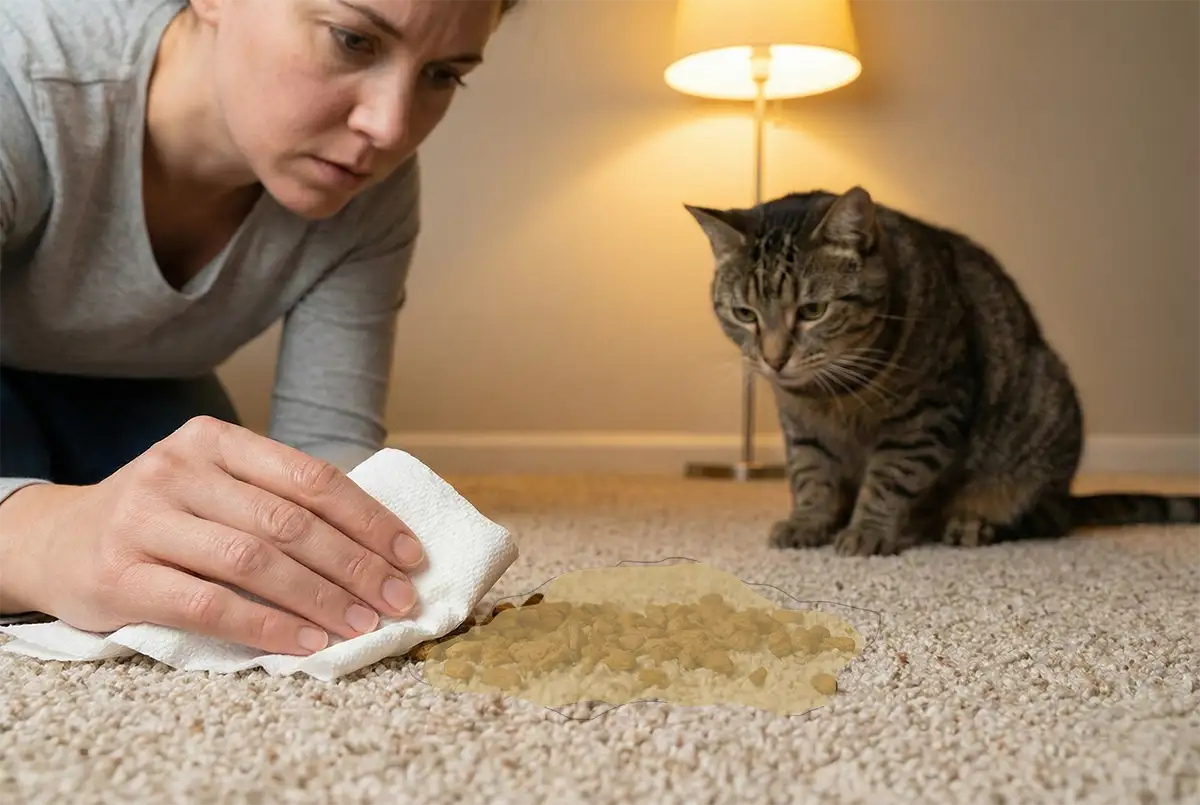
Less than five minutes later, you hear it. That distinctive, rhythmic sound that stops you in your tracks: Hork… hork… hork…
You turn around just in time to see her bring it all back up. And here is the frustrating part: It looks exactly like the breakfast you just served. It hasn’t digested at all. Instead of mush, you see whole, swollen pieces of kibble that look just like they did in the bowl.
It’s gross, it’s messy, and it’s worrying.
As a cat owner, seeing your feline friend throw up undigested food can be confusing. Is she sick? Did she just eat too fast? Or is there something wrong with the food itself? While occasional vomiting is somewhat “normal” in the cat world, throwing up whole, undigested food points to specific issues that are often different from a standard stomach bug.
In this guide, we will break down the difference between “vomiting” and “regurgitation,” explore the 7 most common reasons why this happens, and provide eco-friendly, vet-approved solutions to help your kitty keep her dinner down.
The Big Question: Is It Vomiting or Regurgitation?
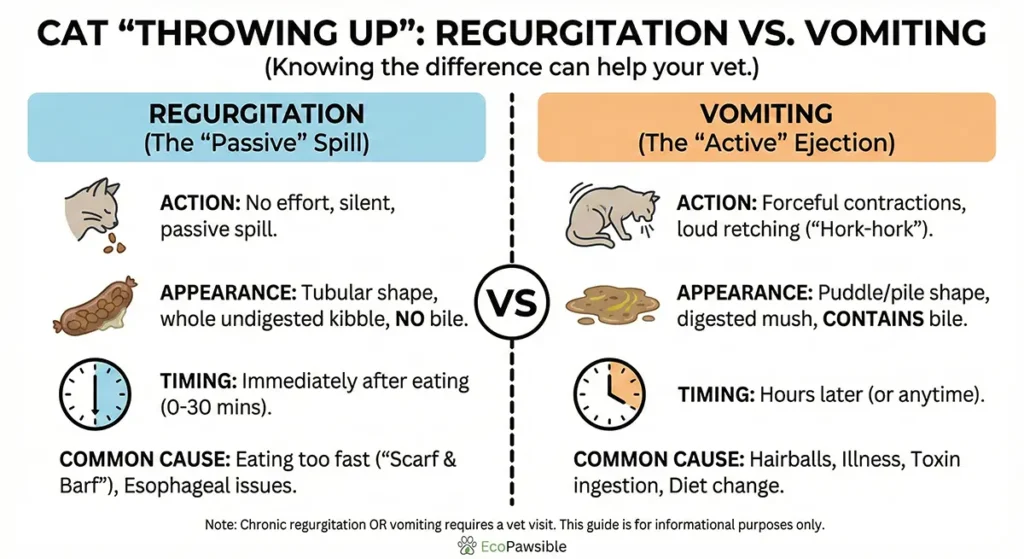
Before you panic, you need to play detective. Believe it or not, there is a biological difference between “vomiting” and “regurgitation,” and knowing the difference is crucial for helping your vet (and your carpet).
Most of the time, when a cat brings up undigested food, they are actually regurgitating, not vomiting.
1. Vomiting (The Active Process)
As explained by the Cornell Feline Health Center, vomiting is an active, forceful ejection of stomach contents.
- The Signs: You will see your cat’s stomach heaving in and out. There is a lot of retching and nausea involved.
- The Look: The mess is usually a mix of partially digested food, yellow or clear liquid (bile), and has a sour smell.
- The Timing: It can happen anytime after eating.
2. Regurgitation (The Passive Process)
Regurgitation happens when food never really makes it to the stomach to begin with. It is rejected from the esophagus.
- The Signs: There is usually no heaving. Your cat might just lower their head, open their mouth, and the food “spills” out effortlessly. It can surprise the cat as much as it surprises you!
- The Look: The food looks tubular (sausage-shaped) because it’s compacted by the esophagus. It looks almost exactly like it did in the bowl, covered in a bit of slime/mucus, but no bile.
- The Timing: Usually happens immediately after eating or drinking (within 30 minutes).
Reason 1: The “Scarf and Barf” Syndrome
By far, the most common reason for throwing up undigested food is eating too fast. In the vet world, this is affectionately known as “Scarf and Barf.”
Why It Happens
Cats are evolutionary predators. In the wild, they might have needed to eat quickly to prevent other animals from stealing their kill. However, in your living room, this instinct just leads to a stomachache.
When a cat inhales dry kibble without chewing, two things happen:
- Air Intake: They swallow a lot of air along with the food.
- Moisture Expansion: Dry kibble absorbs moisture in the stomach and swells up.
If they eat too much, too fast, the stomach wall stretches rapidly. This sends an immediate signal to the brain: “Overload! Eject cargo!”
The Solution: Slow Them Down
You need to make eating a challenge rather than a race.
- Puzzle Feeders: Ditch the standard bowl. Use a puzzle feeder or a “lick mat.” This forces your cat to work for their food, slowing them down and providing mental enrichment.
- The Golf Ball Trick: If you don’t want to buy a new bowl yet, place a clean golf ball or a large smooth stone in the center of their food bowl. They will have to eat around it, which naturally slows their pace.
Reason 2: Hairballs (The Hidden Blockage)
You might think hairballs just look like… well, hair. But often, a hairball is the culprit behind undigested food vomiting.
The Mechanism
If your cat has a large hairball stuck at the exit of their stomach (the pyloric sphincter), food cannot pass through into the intestines. The stomach fills up with dinner, realizes there is nowhere for it to go, and sends it back up.
Signs It’s a Hairball
- You find cylindrical piles of undigested food frequently.
- Occasionally, you find a clump of fur in the mix, but not always.
- Your cat seems constipated or has dry, hard stools.
The Eco-Friendly Fix
Instead of using petroleum-based hairball gels (which are essentially Vaseline), try natural fiber.
- Plain Canned Pumpkin: Add a teaspoon of plain, organic canned pumpkin to their food. The fiber helps push the hair through the digestive tract.
- Brush More Often: The best prevention is removing the loose fur before they swallow it.
Reason 3: Food Intolerance & Low-Quality Ingredients
Sometimes, the problem isn’t how they are eating, but what they are eating.
Many commercial cat foods are packed with fillers like corn, wheat, soy, and artificial dyes (like Red 40). Cats are obligate carnivores; their bodies are designed to digest meat, not carbohydrates. If your cat has a sensitive stomach, their system might identify these fillers as “foreign objects” and reject them immediately.
The “New Food” Rejection
Did you recently switch brands? If you change a cat’s diet too quickly, it can cause immediate gastric upset.
The Fix
- Check the Label: Look for foods with limited ingredients. The first ingredient should always be a named meat (like Chicken or Salmon), not “meat by-product” or “corn gluten meal.”
- Transition Slowly: When changing foods, mix 25% new food with 75% old food, and gradually increase the new food over 7–10 days.
Reason 4: The “Plastic Bowl” Problem (An EcoPawsible Insight)
This is a factor many cat owners overlook. The material of your cat’s food bowl matters.
Plastic is porous. Over time, it develops microscopic scratches that you can’t see with the naked eye. These scratches trap bacteria, old food particles, and oils. Even if you wash the bowl, you can’t fully clean these crevices.
For sensitive cats, eating out of a bacteria-laden plastic bowl can cause mild gastritis (stomach inflammation) or feline chin acne. This low-level nausea can trigger regurgitation after eating.
The Solution
- Upgrade to Ceramic or Stainless Steel: These materials are non-porous and easy to sanitize. They are better for your cat’s health and last a lifetime, reducing plastic waste.
Reason 5: Stress and Environment
Cats are incredibly emotional creatures. Their gut health is directly linked to their stress levels.
If there is construction noise outside, a new puppy in the house, or even if their litter box is dirty, the stress can cause their digestive system to seize up. When a cat is anxious, their body diverts blood flow away from the stomach to the muscles (the “fight or flight” response). If they eat while stressed, that food sits in the stomach like a rock and is eventually thrown up.
Stress often manifests physically. If you suspect your cat is anxious or in pain, it’s a good idea to check their vitals. (Read more: Cat Breathing Fast While Purring: Is It Normal?)“
Reason 6: Improper Meal Scheduling
How often do you feed your cat?
If you only feed your cat once or twice a day with large gaps in between, their stomach becomes highly acidic. When they finally get food, two things happen:
- They are starving, so they eat too fast (back to “Scarf and Barf”).
- The heavy food hits a highly acidic, empty stomach, causing immediate irritation.
The Fix
Switch to smaller, more frequent meals. In the wild, cats eat 10–20 tiny meals a day (mice, bugs, birds). Replicating this by feeding 3–4 smaller portions can settle the stomach.
Reason 7: Medical Issues (When to Worry)
While the causes above are manageable at home, vomiting undigested food can sometimes signal a medical condition.
- Gastritis: Inflammation of the stomach lining.
- Pancreatitis: Inflammation of the pancreas (very painful).
- Obstruction: Did your cat swallow a toy, a hair tie, or a piece of plastic? If the intestine is blocked, food will come back up because it can’t go down.
- Chronic Kidney Disease (CKD): Common in older cats, this causes nausea and frequent vomiting.
Digestive issues often go hand-in-hand with other signs of illness. If your cat is vomiting and also displaying odd habits like sleeping in the litter box, contact your vet immediately.
When Is It a Medical Emergency? (The Red Flags)
If your cat throws up once but acts normal afterwards, it’s likely not an emergency. However, watch out for these red flags. If you see them, skip the blog posts and head to the vet.
- Frequency: Vomiting multiple times in one day, or consistently for more than 24 hours.
- Blood: If the vomit contains red blood or looks like coffee grounds (digested blood).
- Lethargy: If your cat is hiding, sleeping more than usual, or refusing to play.
- Weight Loss: If you notice they feel lighter or their coat looks messy.
Pain: If they growl when you touch their belly.
Summary: Your Action Plan
So, your cat just threw up her breakfast. What should you do?
- Inspect the Vomit: Is it a tube (regurgitation) or a pile (vomit)?
- Check the Bowl: Are you using plastic? Switch to steel.
- Slow Down Dinner: Use a puzzle feeder to stop the “Scarf and Barf.”
- Monitor: Keep a log of when it happens. Is it after eating a specific flavor?
- De-Stress: Ensure their environment is calm and their litter box is clean.
Keeping a clean environment is key to reducing stress. Consider using a dust-free litter to help them breathe easier. (Check out our guide on Wood Pellet Cat Litter Pros and Cons).“
⚠️ Medical Disclaimer
Please note: We are passionate researchers and devoted cat lovers at EcoPawsible, but we are not veterinarians. The information in this article is for educational purposes only and should not replace professional medical advice. If your cat is acting sick, losing weight, or vomiting frequently, please consult with a qualified veterinarian immediately to rule out serious health conditions.